

One of the first vocabulary topics children learn is the names of their body parts.
From pointing to their nose and waving their hands to touching their toes and clapping with excitement, children naturally explore their bodies as they grow and learn.
Teaching body parts in both English and Spanish builds vocabulary while encouraging communication in two languages.
Whether you’re raising bilingual children, introducing Spanish at home, or teaching in a preschool classroom, body parts flashcards provide an engaging, hands-on way to learn through play.
Unlike worksheets that often require children to sit quietly, flashcards encourage movement.
Children can point, touch, repeat, and interact with each word, making lessons feel more like a game than a formal activity.
Parents appreciate flashcards because they make learning simple.
Teachers enjoy using them during circle time and literacy centers.
Homeschool families love the flexibility of practicing for just a few minutes each day.
The best part?
Children often don’t realize they’re learning—they’re simply having fun.
In this complete guide you’ll discover:
- Why learning body parts is important
- Benefits of bilingual vocabulary
- Fun English–Spanish activities
- Classroom games
- Homeschool ideas
- Printable flashcard tips
- Frequently asked questions
- Ready-to-print flashcard inspiration
Whether your child is just beginning to speak or already learning two languages, this guide will help make learning enjoyable and engaging.
Why Learning Body Parts Is Important
Body parts are among the earliest vocabulary words children encounter.
Knowing words like head, eyes, hands, and feet helps children communicate more clearly in everyday situations.
These words are also used during:
- Daily routines
- Songs
- Story time
- Physical activities
- Health and safety lessons
- Classroom instructions
For bilingual learners, understanding body part vocabulary in both English and Spanish creates a strong foundation for future language learning.
🧠 Learning Tip
Children remember new words more easily when they both say the word aloud and point to the matching body part.
Combining movement with speech strengthens memory and keeps young learners engaged.
Benefits of Learning in Two Languages
Learning vocabulary in both English and Spanish offers more than simply knowing two words for the same object.
Bilingual learning encourages children to become flexible communicators and helps them feel comfortable switching between languages in different settings.
Some benefits include:
- Expanding vocabulary
- Improving listening skills
- Supporting memory through repetition
- Building confidence
- Encouraging cultural appreciation
- Preparing children for bilingual classrooms
- Making communication easier with family members who speak different languages
The goal isn’t perfection—it’s creating regular opportunities to hear and use both languages in everyday life.
🌍 Bilingual Tip
Repeat each word in English first, then Spanish.
For example:
Head → Cabeza
Hand → Mano
Keep lessons short and fun. Five to ten minutes of daily practice is often more effective than one long lesson each week.
What Are Body Parts Flashcards?
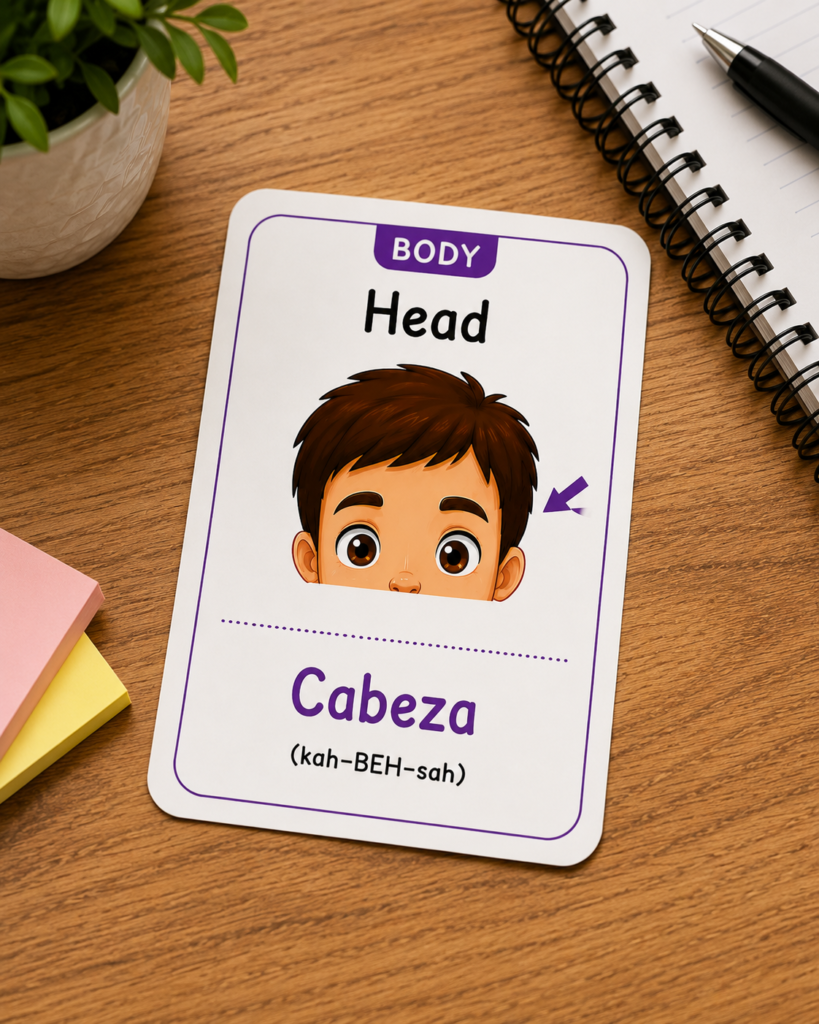
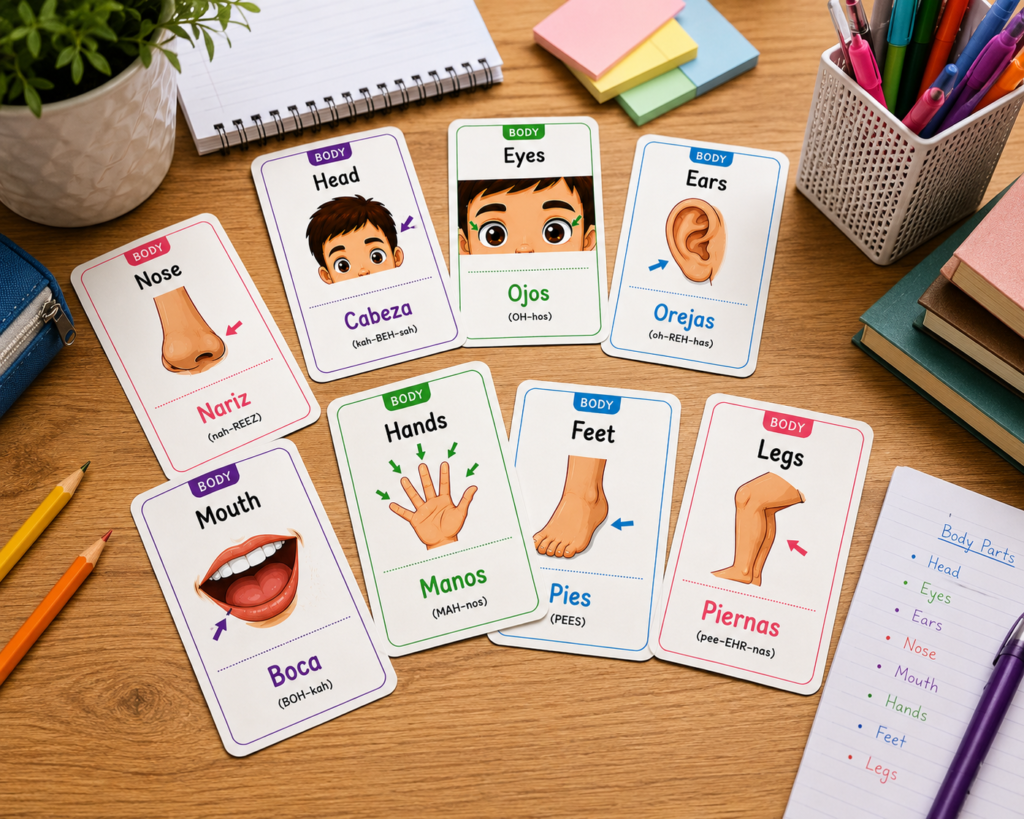
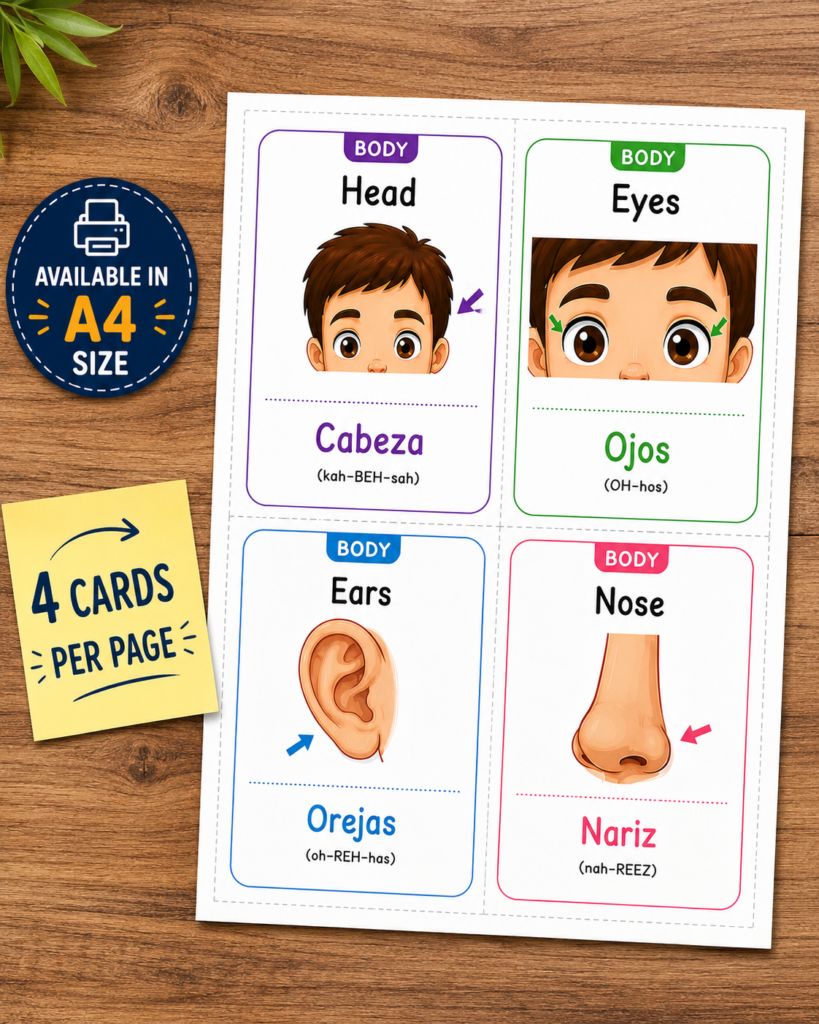
Body parts flashcards are visual learning cards that help children connect pictures, words, and spoken language.
A typical flashcard includes:
- A colorful illustration
- The English word
- The Spanish translation
- Clear, easy-to-read text
- Child-friendly design
Because children can both see and say each word, flashcards support visual, auditory, and hands-on learning all at once.
They’re easy to use at home, in classrooms, or while traveling.
Who Can Use These Flashcards?
One of the greatest strengths of bilingual flashcards is their flexibility.
They’re useful in many learning environments.
Parents
Practice vocabulary during everyday routines like getting dressed or bath time.
Preschool Teachers
Introduce one or two body parts each day during circle time.
Kindergarten Classrooms
Use flashcards for vocabulary lessons, movement games, and language centers.
Homeschool Families
Include them as part of your language arts or early learning curriculum.
ESL & ELL Students
Flashcards help children connect spoken English with familiar Spanish vocabulary.
Speech and Language Support
Visual flashcards can reinforce vocabulary practice alongside other age-appropriate communication activities.
👩🏫 Teacher’s Tip
Display flashcards on a classroom wall at children’s eye level.
When learning centers are open, children can independently review vocabulary throughout the day.
Why Printable Flashcards Are So Popular
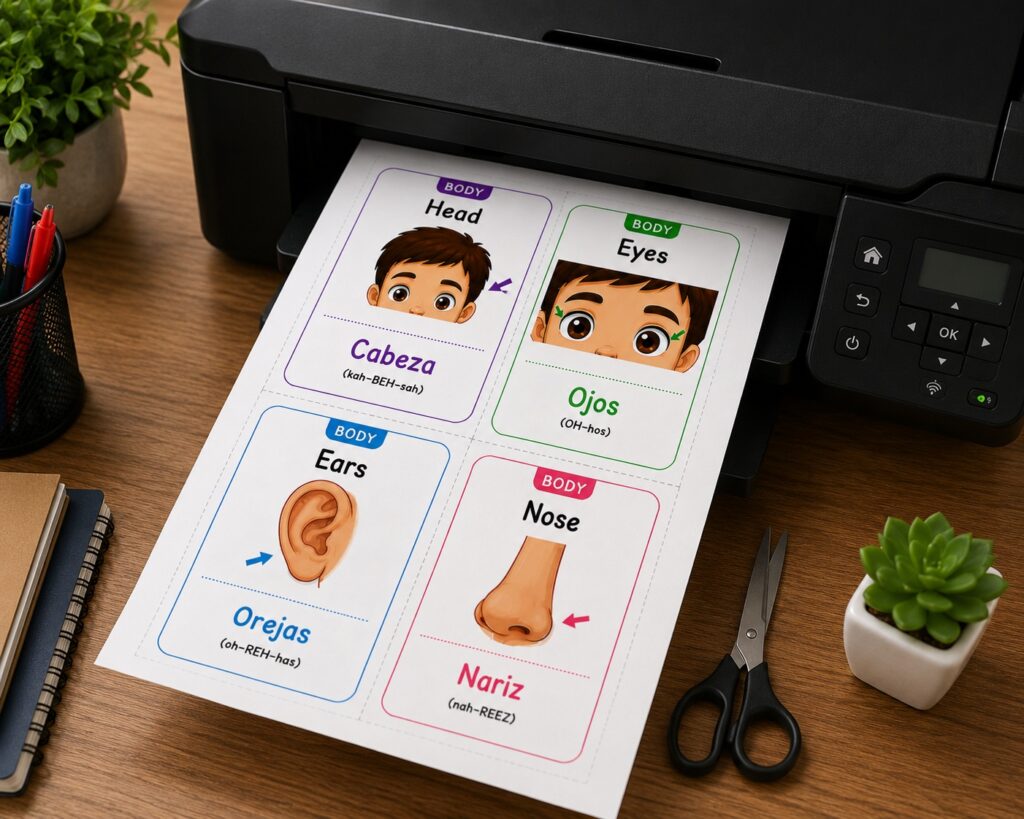
Printable flashcards have become a favorite resource because they’re simple, reusable, and convenient.
Instead of waiting for physical materials, families and teachers can download, print, and begin learning right away.
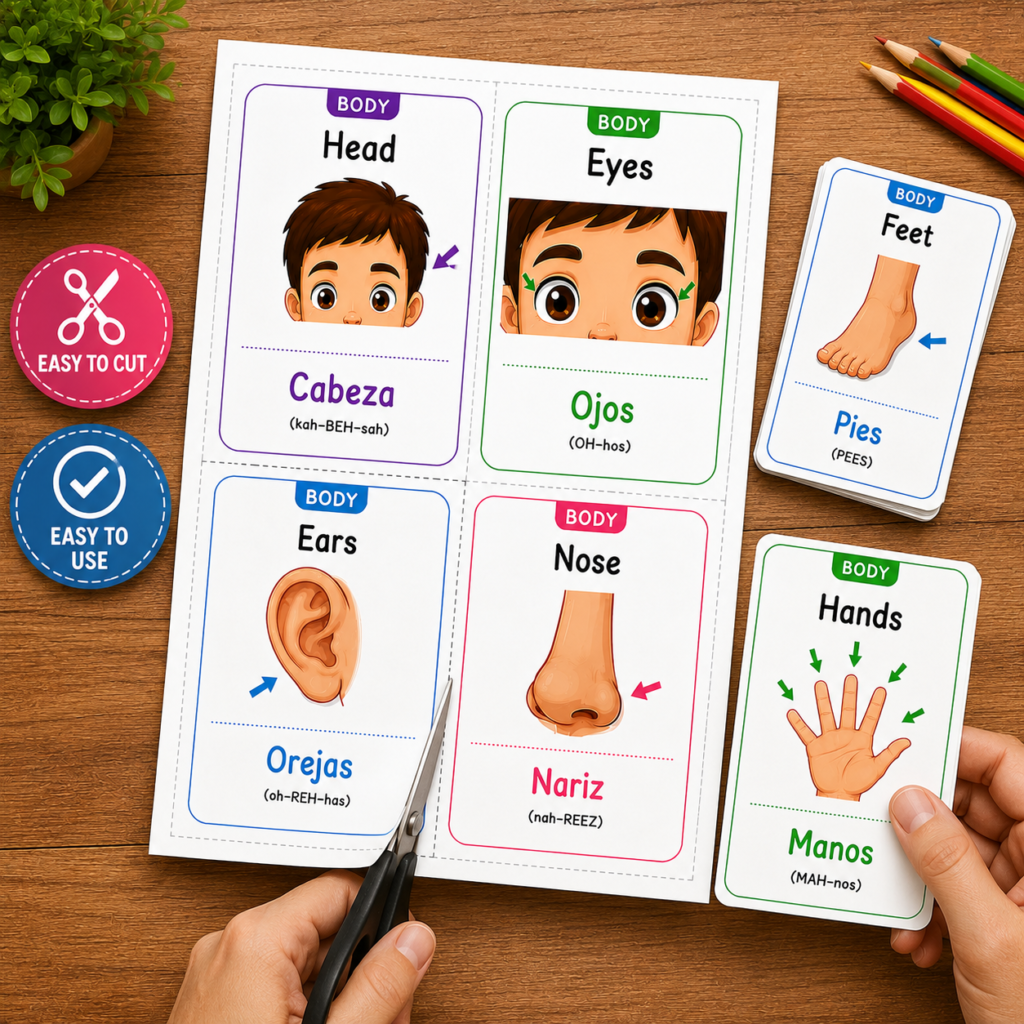
Many educators laminate flashcards so they can be reused for years in classrooms and homeschool settings.
This makes printable resources both practical and cost-effective.
50 Fun Ways to Teach Body Parts with English–Spanish Flashcards
Children learn best when they can move, play, laugh, and explore.
Instead of treating flashcards like a traditional lesson, turn them into interactive games that encourage children to hear, say, and use new vocabulary naturally.
Whether you’re teaching at home, in a preschool classroom, or during homeschool lessons, these activities make learning body parts enjoyable for children of different ages.

Everyday Learning Activities
These simple games fit naturally into daily routines.
1. Point and Say
Hold up a flashcard.
Children point to the matching body part on themselves while saying the word in English and then Spanish.
2. Mirror Game
Stand in front of a mirror together.
Show a flashcard and ask children to point to the matching body part while watching themselves.
3. Copy Me
An adult points to a body part.
Children copy the movement and say the word aloud.
4. Dress-Up Vocabulary
While getting dressed, review flashcards for arms, legs, hands, feet, head, and shoulders.
5. Bath Time Learning
Bath time is a natural opportunity to review body part vocabulary in a relaxed setting.
6. Morning Review
Choose five flashcards to practice before leaving for school.
7. Bedtime Review
End the day by reviewing the same five words together.
8. Flashcard Hunt
Hide flashcards around the room.
Children search for them and name each body part when they find it.
9. Pass the Card
Sit in a circle.
Pass flashcards while music plays.
When the music stops, the child holding the card names the body part.
10. Family Challenge
Ask everyone in the family to find and point to the same body part at the same time.
🧠 Learning Tip
Children remember vocabulary better when lessons last 5–10 minutes and happen consistently throughout the week.
Classroom Activities
Teachers can easily incorporate flashcards into circle time and learning centers.
11. Circle Time Vocabulary
Introduce one new body part each day.
12. Flashcard Wall
Display all learned vocabulary on a classroom wall.
13. Mystery Card
Show only part of a flashcard.
Students guess the body part.
14. Team Match
Match body part words with the correct illustrations.
15. Partner Practice
Children work in pairs to quiz each other.
16. Vocabulary Relay
Students race to pick the correct flashcard after hearing the word.
17. Classroom Bingo
Create bingo boards using body part illustrations.
18. Teacher Says
Play “Teacher Says” instead of Simon Says.
Example:
“Teacher says touch your knees.”
19. Sorting Game
Separate upper body and lower body flashcards.
20. Review Circle
End each lesson by reviewing every new word together.
👩🏫 Teacher’s Tip
Instead of introducing twenty vocabulary words at once, teach 3–5 new words each week and review them often.

Movement Games
Movement helps children remember vocabulary much more effectively.
21. Simon Says
Example:
Touch your head.
Touch your nose.
Touch your ears.
Touch your shoulders.
Repeat in Spanish after each instruction.
22. Freeze Dance
Dance until the music stops.
Hold up a flashcard.
Children touch the matching body part.
23. Jump and Point
Jump three times.
Point to the correct body part.
24. Hop to the Flashcard
Spread flashcards across the floor.
Call out a word.
Children hop to the matching card.
25. Action Cards
Combine movement with vocabulary.
Wave your hand.
Stamp your foot.
Blink your eyes.
Clap your hands.
26. Yoga Vocabulary
Practice simple yoga poses while naming body parts.
27. Stretch and Learn
Touch your toes.
Raise your arms.
Roll your shoulders.
Repeat each word in English and Spanish.
28. Follow the Leader
One child performs a movement.
Everyone copies while saying the matching vocabulary.
29. Obstacle Course
Complete a movement challenge after identifying each flashcard.
30. Musical Flashcards
When the music stops, hold up a flashcard.
Children point to the matching body part.
Bilingual Vocabulary Games
These activities encourage children to switch naturally between English and Spanish.
31. English First
Show the English side.
Children say the Spanish word.
32. Spanish First
Reverse the activity.
33. Matching Pairs
Match English words with Spanish words.
34. Fast Find
Call a word in Spanish.
Children locate the matching flashcard.
35. Memory Match
Print two copies.
Play a matching game.
36. Guess the Card
Describe the body part without showing it.
Children guess.
37. Alphabet Connection
Name a body part that starts with the letter shown.
38. Vocabulary Race
Two children race to find the correct flashcard.
39. Mystery Bag
Place flashcards inside a bag.
Children pull one out and say the word in both languages.
40. Build a Sentence
Examples:
“My hands can clap.”
“Mis manos pueden aplaudir.”
Keep sentences simple and age-appropriate.
🌍 Bilingual Tip
Don’t worry if children mix languages while they’re learning.
Many bilingual children naturally switch between languages during early language development, and that’s a normal part of the learning process.
Creative Extension Activities
Extend learning beyond the flashcards.
41. Draw Yourself
Label the picture in English and Spanish.
42. Build a Paper Person
Add labels to each body part.
43. Sing Body Part Songs
Use familiar songs that include movement and vocabulary.
44. Story Time
Pause during books and identify body parts mentioned in the story.
45. Doctor Role Play
Pretend to visit a doctor and name different body parts.
46. Puppet Play
Use puppets to ask questions.
Example:
“Where is your nose?”
47. Classroom Poster
Create a bilingual body parts display together.
48. Sticker Reward Chart
Celebrate each new group of words children master.
49. Flashcard Review Box
Keep mastered cards in a separate review pile.
50. Vocabulary Celebration
At the end of the week, review everything learned with a fun quiz or game and celebrate progress together.
Sample English–Spanish Vocabulary
| English | Spanish |
|---|---|
| Head | Cabeza |
| Eyes | Ojos |
| Ears | Orejas |
| Nose | Nariz |
| Mouth | Boca |
| Hand | Mano |
| Arm | Brazo |
| Leg | Pierna |
| Foot | Pie |
| Fingers | Dedos |
DIY vs. Printable Body Parts Flashcards
When teaching children body part vocabulary, you have two main options: make your own flashcards or use a professionally designed printable set.
Both approaches have their advantages.
If you enjoy arts and crafts, creating flashcards together can become part of the learning experience. Children often love drawing faces, coloring body parts, and decorating their own cards.
However, many parents and teachers have limited preparation time. Printable flashcards offer a convenient solution that lets you focus on teaching instead of designing materials.
| DIY Flashcards | Printable Flashcards |
|---|---|
| Make cards by hand | Ready to print instantly |
| Fully customizable | Professionally designed |
| Requires art supplies | Minimal preparation |
| Great family craft | Ideal for classrooms and homeschool |
| Time-consuming | Easy to print multiple copies |
Both methods can support successful learning. The most important factor is using the flashcards consistently and making lessons enjoyable.
Save Time with Printable English–Spanish Body Parts Flashcards
If you’re looking for an easy way to teach body parts without creating learning materials from scratch, printable flashcards are a simple solution.
Download the file, print the cards, and start learning at home or in the classroom within minutes.
👉: Get English–Spanish Body Parts Flashcards on Etsy
Tips for Printing Flashcards
A few simple printing choices can make your flashcards more durable and enjoyable to use.
Print on Cardstock
Cardstock is thicker than regular paper and stands up better to daily handling.
Laminate for Long-Term Use
Laminating helps protect flashcards from spills, bending, and classroom wear.
Cut with a Paper Trimmer
A paper trimmer creates clean, even edges and gives your flashcards a professional look.
Store by Topic
Keep body parts flashcards in a labeled envelope, binder pocket, or storage box so they’re always easy to find.
Print More Than One Set
Having multiple sets makes it easier to play matching games, memory games, and partner activities.
Common Mistakes to Avoid
Teaching vocabulary should feel encouraging, not overwhelming.
Here are a few common mistakes and how to avoid them.
Teaching Too Many Words at Once
Focus on just 3–5 new words each week and review them often.
Skipping Review
Children remember more when previously learned words are revisited regularly.
Forgetting Movement
Body part vocabulary is perfect for active learning.
Encourage children to point, clap, stretch, and move while saying the words.
Correcting Every Small Mistake
Learning two languages takes time.
Celebrate progress and gently model the correct pronunciation rather than interrupting every mistake.
Making Lessons Too Long
Young children learn best in short sessions.
Five to ten minutes of focused practice is often more effective than one long lesson.
🧠 Learning Tip
Children often remember vocabulary better when they use several senses at once.
For example, they can:
- See the flashcard.
- Say the word aloud.
- Point to the matching body part.
- Hear the word repeated in the second language.
This combination supports stronger memory and keeps learning engaging.

Frequently Asked Questions
What age is best for body parts flashcards?
Most children begin recognizing basic body part vocabulary between 2 and 5 years old, but printable flashcards can also support older beginner learners and bilingual students.
How often should we practice?
Short daily sessions of 5–10 minutes are usually enough to build vocabulary without overwhelming young learners.
Should I teach English or Spanish first?
There isn’t one correct method.
Many bilingual families introduce the language that feels most natural, then repeat the same word in the second language.
Consistency is more important than the order.
Can teachers use these flashcards in preschool?
Yes.
They’re suitable for circle time, vocabulary lessons, learning centers, partner activities, and movement games.
Can homeschool families use printable flashcards?
Absolutely.
Printable flashcards fit easily into preschool, kindergarten, and early elementary homeschool lessons.
Looking for Ready-to-Print English–Spanish Flashcards?
Printable body parts flashcards are designed to help parents, teachers, and homeschool families introduce bilingual vocabulary with minimal preparation.
Simply print, cut, and start learning together.
👉: Shop English–Spanish Body Parts Flashcards on Etsy
Related Articles
- ASL Flashcards for Kids
- Alphabet Flashcards for Preschoolers
- Number Flashcards for Kids
- Colors Flashcards
- Shapes Flashcards
- Opposites Flashcards
- Preschool Vocabulary Activities
- Homeschool Preschool Curriculum
Final Thoughts
Learning body parts is one of the first steps in building vocabulary, communication, and confidence.
When children explore these words in both English and Spanish, they’re not only learning new vocabulary—they’re developing listening skills, strengthening memory, and becoming more comfortable using two languages in everyday life.
Whether you’re teaching at home, in a preschool classroom, or through a homeschool program, the key is to make learning interactive, encouraging, and fun.
Simple activities, consistent practice, and engaging flashcards can turn a few minutes each day into meaningful learning experiences.
Start Your Bilingual Learning Journey Today
Ready to help children learn body parts in English and Spanish through fun, hands-on activities?
Our printable English–Spanish Body Parts Flashcards are designed for busy parents, teachers, and homeschool families.
✔ Instant Digital Download
✔ Print at Home or School
✔ Child-Friendly Illustrations
✔ Perfect for Preschool & Kindergarten
✔ Reusable Year After Year